Seabrook Texas Town
Museum
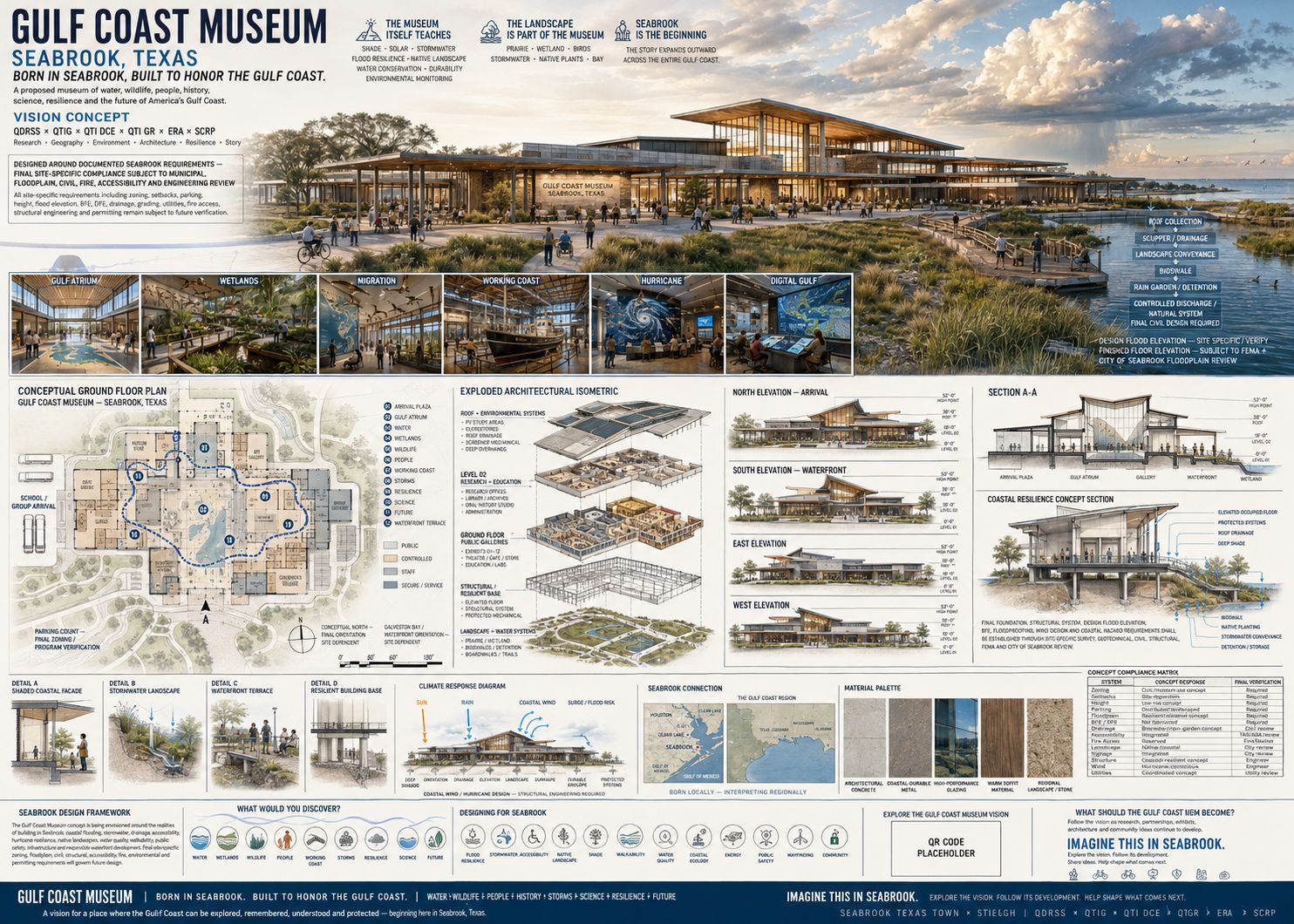
The vision
Scroll inside to read on.
SEABROOK TEXAS TOWN
GULF COAST MUSEUM
A FUTURE SEABROOK TEXAS TOWN × STELGH DEVELOPMENT
Born in Seabrook. Built to honor the Gulf Coast.
More updates coming soon as research, planning, partnerships and development continue.
Some ideas begin with a building.
This one begins with something much larger.
It begins with the water.
With the wetlands.
With the marshes and bays.
With the birds overhead and the life beneath the surface.
With fishing boats leaving before sunrise.
With families who have lived beside the Gulf for generations.
With scientists studying an environment that never stops changing.
With artists trying to capture what it feels like to live here.
With hurricanes that changed communities forever.
With people who rebuilt.
With stories passed from one generation to another.
And with a simple belief:
The Gulf Coast deserves a place dedicated to telling the whole of its story.
That is what we are working toward.
Seabrook Texas Town and STELGH are working toward the long term development of a Gulf Coast Museum, a future physical and digital destination dedicated to understanding, preserving, studying, experiencing and celebrating the extraordinary natural and human story of the Gulf Coast.
The museum does not exist as a physical building today.
There is not an announced opening date.
There is not yet a publicly announced museum site.
But the vision is real, the research foundation is developing, and the work of determining what this museum can become has begun.
This is a long term development mission.
And as that mission advances, we are going to bring you along with us.
Why a Gulf Coast Museum?
Because the Gulf Coast is much more than a line where land meets water.
It is an enormous living system.
It is wetlands and coastal prairie.
Barrier islands and beaches.
Bays and estuaries.
Marshes and rivers.
Forests and shorelines.
Bird migration corridors and marine habitat.
It is fishing communities and working waterfronts.
Ports and marinas.
Boats and ships.
Energy and industry.
Tourism and recreation.
Science and conservation.
Food and music.
Art and architecture.
Indigenous history and generations of settlement.
Families and neighborhoods.
Hurricanes and recovery.
Environmental loss and environmental restoration.
It is people building beside water while continually learning what it means to live with that water.
These stories are often told separately.
We want to explore what becomes possible when they are brought together.
A place to understand the Gulf Coast as a whole
The long term Gulf Coast Museum vision is not simply to create another building containing objects behind glass.
We envision something much more alive.
A place where you can understand how water shaped communities.
A place where a child can discover why wetlands matter.
A place where someone can follow the migration of a bird across continents and discover why the Gulf Coast became part of its journey.
A place where historic maps can be placed beside modern environmental data and reveal how a shoreline changed.
A place where hurricane science can exist beside the voices of people who actually lived through those storms.
A place where a fisherman, scientist, artist, historian, engineer and child can each contribute a different way of understanding the same coast.
A place where technology helps us see relationships that would otherwise remain invisible.
A place where history is not separated from science and where nature is not separated from people.
A place where the Gulf Coast can be studied, remembered, experienced and celebrated.
The idea begins in Seabrook
There is something appropriate about this vision beginning here.
Seabrook sits within the living laboratory of Galveston Bay.
Around us are marinas, wetlands, shorelines, birds, fishing, sailing, recreation, working infrastructure, environmental restoration, waterfront neighborhoods and generations of Gulf Coast history.
We live with heat.
Rain.
Salt air.
Wind.
Flooding.
Storms.
Migration.
Changing seasons.
And the constant relationship between land and water.
Seabrook does not represent every Gulf Coast community.
It should never pretend to.
But it provides a meaningful place from which to begin asking larger questions about the Gulf Coast.
That is why the philosophy behind this project is:
Born in Seabrook. Built to honor the Gulf Coast.
Seabrook is the starting point.
The Gulf Coast is the subject.
This will not simply be a Seabrook museum
The long term vision reaches outward.
- Texas
- Louisiana
- Mississippi
- Alabama
- Florida
And, as the research develops, the larger environmental and cultural connections created by the Gulf itself.
Every Gulf Coast community is different.
That difference matters.
A fishing community in Louisiana should not be reduced to the same identity as a waterfront community in Texas.
A Florida barrier island tells a different story from a Mississippi marsh.
A Texas port has a different history from an Alabama coastal town.
The objective should never be to flatten those differences into one generic idea of coastal life.
It should be to connect them while preserving what makes each one distinct.
What does it mean to honor the Gulf Coast?
It means celebrating its beauty without ignoring its vulnerability.
It means talking about recreation without forgetting the people whose livelihoods depend upon these waters.
It means discussing environmental protection alongside development.
It means studying hurricanes while remembering the human beings behind the storm tracks.
It means understanding ports as both economic engines and enormous pieces of coastal geography.
It means recognizing fishing as recreation, culture, food and livelihood.
It means documenting environmental change.
It means listening to communities.
It means respecting the Indigenous histories that precede modern cities and approaching those histories through careful research and appropriate collaboration.
It means remembering people who rebuilt after disasters.
It means recognizing scientists and environmental stewards working on what comes next.
And it means preserving ordinary stories that may otherwise disappear.
Water
Imagine entering a museum experience devoted to the force connecting the entire region.
Water.
- Bays
- Estuaries
- Rivers
- Currents
- Tides
- Freshwater
- Saltwater
- Rain
- Flooding
- Storm surge
- The Gulf itself
Visitors could explore how water creates habitat, moves sediment, supports economies, influences weather, shapes cities and changes coastlines.
Water would not simply be scenery.
Visitors would begin understanding it as a system.
Land
Then move into the landscapes created through that relationship with water.
- Wetlands
- Marshes
- Coastal prairie
- Barrier islands
- Dunes
- Shorelines
- Forests
- Estuaries
Visitors could see how these environments formed, what lives within them, how people have altered them and what restoration can accomplish.
Historic imagery could stand beside contemporary maps.
A child could watch decades of shoreline change occur in seconds.
A researcher could see something completely different in the same information.
That is the kind of layered experience we want to explore.
Wildlife
Then look up.
The Gulf Coast is part of enormous wildlife systems that extend far beyond municipal, state and even national boundaries.
Bird migration alone can connect Seabrook with places thousands of miles away.
The museum could help visitors follow those journeys.
- Birds
- Fish
- Marine mammals
- Shellfish
- Reptiles
- Pollinators
- Native plants
- Food webs
- Habitats
Instead of simply identifying species, we want people to understand relationships.
Why is this animal here?
What does it need?
Where did it come from?
Where is it going?
What happens when its habitat changes?
Those are the questions that turn observation into environmental understanding.
People
Then come the people.
Because the Gulf Coast is not simply geography.
It is home.
It is generations of families.
- Fishermen
- Shrimpers
- Sailors
- Dock workers
- Shipbuilders
- Scientists
- Artists
- Teachers
- Gardeners
- Engineers
- Business owners
- Restoration workers
- Volunteers
- Conservationists
- First responders
- Storm survivors
Children growing up beside the water.
People who arrived yesterday.
People whose families have been here for generations.
Their voices should matter.
The future museum should not simply tell visitors what happened to people.
Whenever possible, it should allow people to tell their own stories.
Weather, hurricanes and resilience
You cannot honestly tell the story of the Gulf Coast without storms.
Hurricanes have changed our shorelines.
Changed buildings.
Changed infrastructure.
Changed laws.
Changed engineering.
Changed families.
Changed memories.
And changed how communities think about what they build next.
The museum could connect hurricane science with human history.
Storm tracks with oral histories.
Storm surge models with photographs.
Engineering changes with the events that made those changes necessary.
Recovery with resilience.
The objective would not be to sensationalize disaster.
It would be to understand it.
Because living on the Gulf Coast means understanding that the same environment capable of extraordinary beauty can also possess extraordinary power.
Science and the future
The Gulf Coast story is still being written.
That means this cannot become a museum frozen in the past.
- Environmental monitoring
- GIS
- Remote sensing
- Water quality
- Habitat science
- Restoration
- Coastal engineering
- Data visualization
- Artificial intelligence
- Changing shorelines
- New environmental technologies
All of these can become part of understanding what happens next.
We envision a living museum where knowledge can continue changing as the coast changes.
Imagine a living digital Gulf Coast
One of the most ambitious long term possibilities is creating a digital geographic representation of the Gulf Coast.
Imagine standing before a massive interactive map.
- Touch Seabrook.
- Its story opens.
- Touch Galveston Bay.
- Explore habitat, history and environmental data.
- Move east along the coast.
- Discover another community.
- Then another.
Follow a hurricane.
Follow a bird.
Follow a watershed.
Watch shorelines change through time.
Explore restoration.
Compare wetlands.
See cities grow.
Hear residents speak.
Discover artwork created in those places.
Explore environmental research associated with them.
That is where GIS, environmental intelligence, history, storytelling and museum interpretation can begin coming together.
The museum before the museum
And here is one of the most important parts of this project:
We do not have to wait for a building to begin the work of a museum.
We can begin now.
Every environmental study can contribute knowledge.
Every map can become part of an archive.
Every historic photograph can preserve a moment.
Every resident story can preserve a memory.
Every conversation can capture knowledge.
Every artist can interpret something about this region.
Every wildlife observation can teach.
Every historical record can add context.
Every environmental dataset can help us understand change.
Every community contribution can become another piece of a much larger Gulf Coast story.
That means the digital work happening through STELGH and Seabrook Texas Town can begin creating what we think of internally as the museum before the museum.
- Collect
- Document
- Research
- Preserve
- Interpret
- Teach
- Connect
- Share
The physical building is a future home for the mission.
The mission itself can begin now.
That is where STELGH comes in
STELGH's work is being developed around environmental research, geographic information, habitat documentation, ecological storytelling, public education, community participation, environmental stewardship and the connections between Gulf Coast communities.
That research has value beyond an individual project.
Environmental audits can become future educational resources.
GIS layers can become interactive experiences.
Habitat studies can inform exhibits.
Historical research can contribute to archives.
Wildlife documentation can support educational programming.
Community stories can become oral histories.
Geographic comparisons can help people understand how coastal communities are connected.
In that sense:
STELGH helps document the Gulf Coast.
The Gulf Coast Museum is the long term vision for helping people physically experience that knowledge.
And that is where Seabrook Texas Town comes in
Seabrook Texas Town approaches the same mission through another doorway.
- People
- Travel
- Community
- Artists
- Businesses
- History
- Environment
- Coastal culture
- Stories
- Visitors
The digital platform can introduce somebody on the other side of the world to Seabrook today.
The museum vision asks what could happen tomorrow if those digital stories eventually had a physical destination.
The website can help someone discover the Gulf Coast.
The future museum could invite that person to walk through its story.
Art belongs here
Science tells us one kind of truth about a place.
Art can tell us another.
A photograph can capture something a dataset cannot.
A painting can communicate how somebody feels about a landscape.
Music can preserve cultural memory.
Film can capture voices and environments.
Writing can preserve experiences.
Sculpture can turn environmental ideas into physical form.
The long term museum vision therefore includes artists not simply as decoration around scientific exhibits, but as interpreters of Gulf Coast identity.
- Painters
- Photographers
- Writers
- Musicians
- Filmmakers
- Designers
- Craftspeople
- Sculptors
- Creators
The future museum should ask:
How does the Gulf Coast see itself?
Artists can help answer that question.
Children belong at the center
We want the Gulf Coast Museum to become somewhere a child remembers.
Not because someone forced them to stand quietly and read a wall of text.
Because they touched something.
Saw something.
Asked something.
Tested something.
Discovered something.
And went home wanting to know more.
Why are wetlands important?
What is an estuary?
Where does this bird go after it leaves Texas?
How does a hurricane form?
Why does storm surge happen?
How does an oyster reef affect its environment?
Why is the shoreline moving?
What lived here before this city existed?
How does a marsh protect land?
What can I do to help?
Those questions matter.
The museum should encourage them.
Make science something people can experience
- Interactive Gulf Coast maps
- Water flow demonstrations
- Storm surge simulations
- Habitat models
- Bird migration displays
- Microscopes
- GIS walls
- Historic imagery
- Coastal engineering demonstrations
- Environmental monitoring
- Oral history stations
- Digital artwork
- Changing research exhibits
Instead of simply telling visitors that something happens, allow them to explore why it happens.
Turn data into experiences.
Turn information into discovery.
Connect science with history
A hurricane is science.
It is also history.
A fishing community is culture.
It is also ecology.
A port is industry.
It is also geography.
Wetland loss is environmental change.
It is also human history.
A seawall is engineering.
It is also evidence of decisions a community made in response to its environment.
These subjects should not live in completely separate rooms.
The Gulf Coast does not experience them separately.
Neither should the visitor.
Preserve what is changing
The coast changes.
Sometimes slowly.
Sometimes overnight.
Historic maps and photographs can reveal shoreline movement.
Environmental records can show habitat change.
Satellite imagery can reveal urban growth.
Restoration projects can demonstrate recovery.
Storm records can document destruction.
Oral histories can preserve what maps cannot.
This creates an opportunity to build an institution concerned not simply with what the Gulf Coast was, but also: what it is, and what it is becoming.
Honor the working Gulf Coast
The Gulf Coast is not simply somewhere people vacation.
It works.
- Fishing
- Shrimping
- Shipping
- Ports
- Energy
- Boat building
- Marinas
- Seafood
- Transportation
- Infrastructure
- Construction
- Science
- Tourism
Thousands upon thousands of people make their livelihoods through relationships with the coast.
That working identity belongs in the museum.
Visitors should leave understanding that the beautiful waterfront they see is also connected to enormous systems of labor, commerce, infrastructure and human knowledge.
Preserve memories before they disappear
One of the most important collections may not begin with artifacts.
It may begin with people.
Older residents possess memories that exist nowhere else.
Families possess photographs that may never have entered a public archive.
Fishermen remember changes in the water.
Residents remember hurricanes.
Workers remember industries.
Artists remember places that no longer look the same.
Communities remember neighborhoods differently than maps remember them.
Those memories matter.
A future Gulf Coast community archive could help preserve:
- photographs
- documents
- family histories
- videos
- oral histories
- artifacts
- maps
- stories
- personal recollections
Because history disappears quietly when nobody asks someone to tell it.
Bring generations into the same room
Older residents possess memories.
Scientists possess data.
Artists possess interpretation.
Children possess questions.
Imagine putting all four together.
That may ultimately be one of the most important things this museum can accomplish.
A museum that reaches outside its walls
The Gulf Coast Museum should not stop at the building.
The long term vision can eventually explore outdoor experiences such as native landscapes, demonstration gardens, environmental interpretation, bird observation, outdoor classrooms, public art, trails and coastal restoration education.
If a physical site is eventually selected and developed, the architecture itself should also be part of the lesson.
- Storm resilience
- Water sensitive design
- Native landscaping
- Energy efficiency
- Shade
- Rain management
- Habitat
- Environmental interpretation
The building should not simply contain the environmental message.
The building should help demonstrate it.
A research institution as well as a visitor destination
The long term vision can reach beyond traditional museum programming.
Imagine space for:
- GIS
- environmental records
- historic archives
- public data
- research collaboration
- student projects
- environmental education
- scientific communication
- changing Gulf Coast research
- Universities
- Schools
- Scientists
- Historians
- Environmental organizations
- Artists
- Nature centers
- Researchers
- Municipalities
- Community organizations
The museum could eventually become a place where these worlds meet.
Not a solitary institution.
A network.
A destination worth traveling to
This is also where the Gulf Coast Museum connects directly with the ecotourism mission of Seabrook Texas Town.
The museum should eventually become more than something residents visit once.
The ambition is to create something distinctive enough that a person elsewhere says:
I want to go see that.
- Someone could discover Seabrook Texas Town online.
- Learn about Galveston Bay.
- Discover an artist.
- Explore Gulf Coast wildlife.
- Find the museum project.
- Follow its development.
- Eventually plan a trip.
- Come to Seabrook.
- Visit the museum.
- Eat locally.
- Explore the waterfront.
- Discover other Gulf Coast destinations.
And leave understanding the region differently than when they arrived.
That is where education, tourism and community economic activity begin supporting one another.
The entire Gulf Coast can eventually participate
This should not become a story told only from one place.
We want future opportunities for Gulf Coast communities to contribute their own:
- history
- photography
- art
- science
- environmental projects
- restoration work
- oral histories
- community stories
- research
- educational resources
If the museum says it exists to honor the Gulf Coast, then the Gulf Coast should have opportunities to speak.
What could your community teach the rest of us?
That may become one of the most important questions we ask.
What Gulf Coast story should never be forgotten?
What should children understand about your coast?
What changed?
What disappeared?
What survived?
What was rebuilt?
What wildlife defines your community?
What environmental problem are people trying to solve?
What artist sees your landscape differently?
What family story deserves preservation?
What should someone visiting from another country understand before they leave?
Those questions can begin long before a museum building opens.
A future State of the Coast experience
One long term possibility is a changing annual experience devoted to the State of the Gulf Coast.
What happened this year?
What changed environmentally?
What was restored?
What storms occurred?
What did scientists discover?
What wildlife stories emerged?
What communities accomplished something remarkable?
What challenges remain?
What should we watch next?
That could help keep the museum continually evolving instead of becoming a static collection of yesterday's information.
How the long term funding vision fits
A vision this large eventually requires serious resources.
Part of the long term purpose behind building the STELGH ecosystem is to create financial capacity that can support larger environmental education and public facing projects, including development of the Gulf Coast Museum vision.
As specific museum funding mechanisms are established, the goal should be transparency.
If a defined portion of qualifying sales is eventually dedicated to museum development, that commitment should be clearly documented.
People should be able to understand what is being raised, what it supports and how the project is progressing.
We do not want to pretend that buying one product magically builds a museum.
We want to build the economic, research, community and partnership foundation capable of moving a serious institution forward over time.
What stage are we in today?
We want to be clear.
CURRENT STATUS
The Gulf Coast Museum is a long term development objective.
Research and concept development are underway.
The digital knowledge foundation is being developed.
Future community outreach and partnership development are part of the strategy.
Funding structures will continue to be developed.
A physical museum site has not yet been publicly announced.
Construction has not begun.
An opening date has not been established.
That is why COMING SOON on Seabrook Texas Town means something very specific right now:
More information, research, concepts, participation opportunities and development updates are coming soon.
It does not mean we are pretending there is already a museum waiting behind the map button.
We want you to watch something develop.
The road from idea to institution
A project of this scale develops in stages.
- Research and concept development.
- Community and Gulf Coast outreach.
- Partnership development.
- Funding strategy.
- Potential site evaluation.
- Programming.
- Exhibit planning.
- Architectural feasibility.
- Capital development.
- Design.
- Approvals.
- Construction.
- Exhibit installation.
- Opening.
We are at the beginning of that road.
But every serious institution began somewhere.
This is where this one begins.
And you can be part of that beginning
You do not need to be a scientist.
You do not need to own an artifact.
You do not need to represent an institution.
Maybe you have an old photograph.
A family story.
A hurricane memory.
A fishing story.
A piece of artwork.
Knowledge about birds.
A historical document.
A photograph of a place that has changed.
A story about your community.
Professional expertise.
A research idea.
A connection to a potential partner.
Or simply an opinion about something the Gulf Coast Museum should teach future generations.
Those contributions can matter.
Follow the development.
Share the project.
Share stories.
Help identify history worth preserving.
Connect us with expertise.
Introduce organizations doing meaningful Gulf Coast work.
Support STELGH.
Participate when community research and museum development opportunities are announced.
And most importantly, help us answer the question:
What should future generations understand about the Gulf Coast?
This is bigger than a museum building
Ultimately, the physical museum is one part of a larger idea.
The real objective is preservation.
- Understanding
- Research
- Education
- Connection
- Memory
- Stewardship
- Curiosity
We want future generations to have somewhere they can walk through the Gulf Coast story and understand that this region is much more than a shoreline drawn across a map.
It is home.
It is habitat.
It is history.
It is science.
It is culture.
It is work.
It is art.
It is memory.
It is vulnerability.
It is resilience.
And it is possibility.
We are not announcing a finished museum today.
We are announcing the direction we are working toward.
The Gulf Coast has given generations of people places to live, work, fish, create, explore, study, rebuild and call home.
It has shaped our history.
Our economies.
Our wildlife.
Our communities.
Our cultures.
Our memories.
And our lives.
We believe that story deserves a place of its own.
That is the long term goal behind the Gulf Coast Museum.
The work begins with research.
With documentation.
With environmental study.
With community stories.
With maps.
With photographs.
With history.
With art.
With science.
With partnerships.
With building resources.
And with people who believe the Gulf Coast deserves to be understood as deeply as it deserves to be celebrated.
The museum does not exist yet.
The vision absolutely does.
The research has begun.
The digital foundation is being built.
The long term mission is established.
And we will continue sharing the journey as it develops.
MORE UPDATES COMING SOON
GULF COAST MUSEUM
Born in Seabrook. Built to honor the Gulf Coast.
A future Seabrook Texas Town × STELGH development.
The Gulf Coast is the story. We are working toward building a place where that story can live.